Carbon farming is often spoken about as a single category, but different carbon projects work in very different ways. On a grazing property, those differences shape how a project is designed, how carbon is measured, and what it means for land use, vegetation management and future flexibility.
For Queensland producers weighing up soil carbon, the challenge is often less about the opportunity itself and more about the assumptions attached to the words “carbon farming.”
Does it mean locking up land? Does it mean planting trees? Will it affect grazing decisions? Could it create issues with banks, valuers or future property plans?
These are all valid questions, and all reasons to understand what kind of carbon project is being discussed before ruling soil carbon in or out.
New to soil carbon?
You may want to start with our guide on what soil carbon farming is before comparing different project types.
In this article, we’ll cover:
- Why carbon farming is often misunderstood
- The difference between soil carbon and tree carbon projects
- Why soil carbon farming doesn’t automatically mean locking up grazing land
- Whether a soil carbon project can dictate stocking rates
- How Queensland land clearing rules fit into soil carbon project design
- What Carbon Estimation Areas are and why they matter
- How EPBC changes are influencing producer uncertainty
- How CarbonLink supports property-specific project design
Carbon farming resistance often starts with the wrong mental model
There’s still a perception that carbon farming locks up country.
It’s one of the most common concerns CarbonLink hears from producers, particularly in grazing regions where land use, vegetation management and operational flexibility are central to how a business runs.
CarbonLink Carbon Farming Advisor Brenton Wenham says many producers come into early conversations with concerns shaped by the broader carbon market.
“One of the biggest misconceptions is the belief that all carbon projects are the same and that they involve locking up productive country,” Brenton says.
“Producers are also commonly concerned about long-term commitments, additional restrictions on land management, and uncertainty around future policy settings.”
These concerns don’t come from nowhere. Tree-based carbon projects have been around longer, represent a larger share of the market, and have received more public attention. For many producers, that’s shaped the picture they see when they hear the term “carbon farming”.
The problem starts when assumptions about tree carbon are applied to other types of carbon projects, including soil carbon projects.
Same market, different mechanics
Soil carbon and tree carbon projects both store carbon, but they store it in different parts of the landscape.
“The easiest way to understand the difference is that tree carbon is stored in the vegetation you can see, while soil carbon is stored below ground,” Brenton says.
Tree-based carbon projects store carbon in living biomass – trunks, branches, leaves and roots – so the carbon outcome is tied to vegetation growth.
“Soil carbon is different because we’re looking at what’s happening within the soil profile,” Brenton says. “That includes organic matter and mineral-bound carbon, with deeper soil carbon often considered more stable over time.”
It’s a practical difference for grazing producers. Tree carbon projects are generally associated with establishing, protecting or managing vegetation, while soil carbon projects are designed around eligible land management activities on agricultural land.
The two also differ in how carbon is measured. Tree carbon projects are generally modelled; soil carbon projects require physical soil sampling and analysis, because soil carbon can change significantly across a landscape. Rainfall, soil type, management practices, land condition and seasonal variability can all influence results.
When conducting soil carbon measurement in a project, CarbonLink uses NetScan, its soil condition analysis technology using spectroscopy acquired from CSIRO, to support accurate, efficient assessment of soil organic carbon (SOC) across the profile.
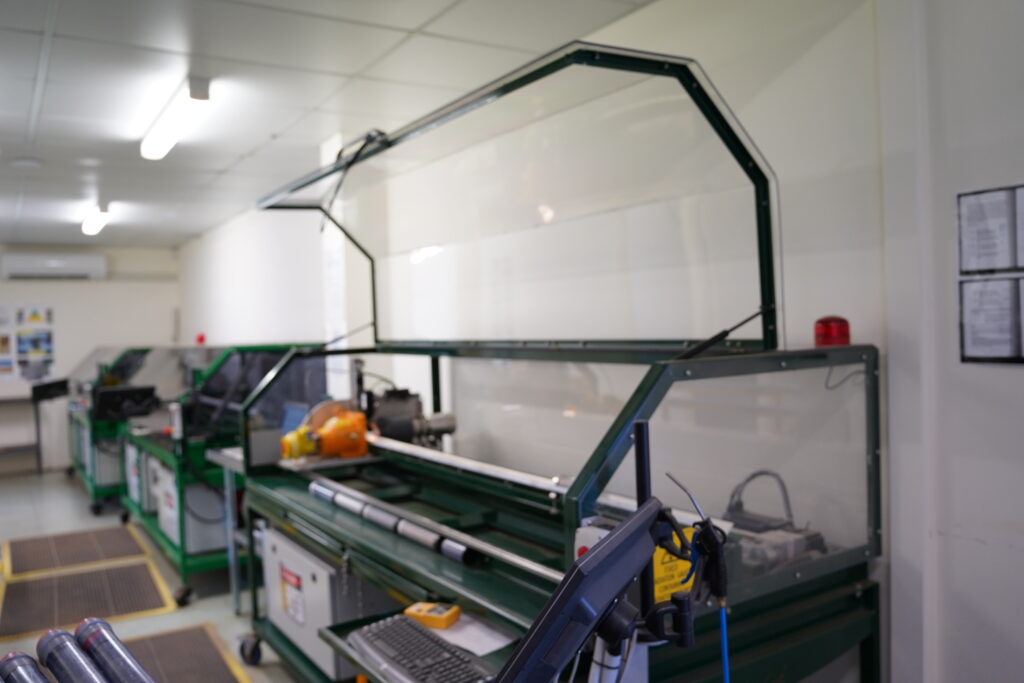
CarbonLink’s NetScan technology at the Laboratory in Gladstone, Queensland.
Working country, not locked country
One of the first questions producers ask about soil carbon is what they might be giving up.
A soil carbon project isn’t designed to lock up productive grazing land or remove it from agricultural use. Producers commit to implementing and maintaining eligible land management activities designed to increase soil carbon sequestration, and to meeting the monitoring, auditing and record-keeping requirements under the soil carbon method and carbon farming legislation.
What they’re not doing is signing away their land or giving up their agricultural enterprise.
“Soil carbon projects are designed to work alongside productive farming businesses,” Brenton says.
In fact, many of the practices that support soil carbon are already recognised as good farming principles. Keeping (or increasing) ground cover, managing grazing, giving pasture time to recover and protecting land condition all contribute to a more resilient production system.
And the practices used in a soil carbon project aren’t necessarily set in stone. If the business, season or property needs change, the practices can evolve too; provided they continue to meet the requirements of the method.
Stocking decisions stay with the producer
On a grazing property, stock numbers shift with the season. Rainfall, feed availability, land condition and business needs all shape how producers run their enterprise, so it makes sense they want to know whether a soil carbon project could affect those decisions.
Some of this concern carries over from vegetation-based projects, where grazing pressure may need to be managed if livestock are impacting tree or vegetation establishment. When applied to soil carbon, producers understandably worry they could be forced to destock, particularly in dry conditions.
In a CarbonLink soil carbon project, stocking decisions remain with the producer. CarbonLink doesn’t set stocking rates or require forced destocking.
The project is built around eligible land management practices while allowing producers to respond to the season, the condition of their country and the needs of their enterprise.
A strong soil carbon project should be clear about what’s required, how the project will be managed, and where the producer retains flexibility.
The rules still apply
A soil carbon project doesn’t lock up a whole property, but land clearing and vegetation management still need to be understood clearly, especially in Queensland.
CarbonLink Project Manager Cameron White says one common misunderstanding is that a soil carbon project automatically adds vegetation management restrictions across the entire property.
“In reality, all existing local, state and federal vegetation management laws continue to apply, regardless of whether a carbon project exists,” Cameron says.
The next thing to understand is how baseline forest cover is treated within Carbon Estimation Areas, or CEAs.
Baseline forest cover generally refers to areas that meet Australia’s forest definition – at least 20 per cent canopy cover, across 0.2 hectares or more, with vegetation that has a height of at least two metres – in the five years before project registration.
“If an area of baseline forest cover is included within a CEA, restrictions on clearing or thinning may apply under the soil carbon method,” Cameron says. “But those restrictions are limited to those areas of the CEA, not the entire property.”
So a soil carbon project doesn’t create blanket land clearing restrictions across every paddock. It still needs careful design though, to ensure that producers have a say in what’s included, what’s excluded, and how the project may interact with future land management plans
Where the map matters
In a soil carbon project, the way the property is mapped influences what land is measured, what’s left out, and how much flexibility the producer retains for future decisions.
A Carbon Estimation Area, or CEA, is the part of a soil carbon project where eligible management activities are carried out and soil carbon is measured over time.
Good CEA design affects measurement confidence, sampling requirements, project cost, compliance and operational flexibility.
“Reducing variability within a CEA is one of the key indicators of good design, because it ensures the project is comparing apples with apples,” Cameron says.
In practical terms, that means grouping areas with similar soil and landscape characteristics so changes in soil carbon can be measured more accurately. More sampling can reduce variability, but it also increases cost.
CarbonLink uses geospatial data, soil information, analytical tools and producer knowledge of the land to shape CEAs that support accurate measurement and make sense for the property.
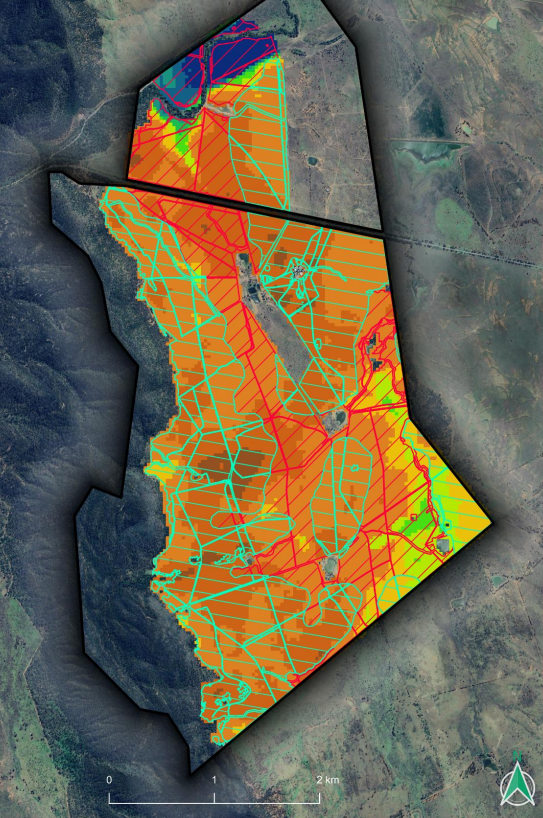
Example of GIS Mapping completed by CarbonLink during soil carbon project design.
Designing through uncertainty
Changes to national land clearing rules under the Environment Protection and Biodiversity Conservation Act (EPBC Act) have raised questions for some Queensland producers.
For CarbonLink, these questions are addressed during project design. Vegetation cover, land management requirements and regulatory risk are already reviewed as part of the development process.
CarbonLink also support clients throughout the project lifecycle to navigate potential impacts to their project caused by changes in legislation (like the EPBC Act), and any subsequent impacts these have on their land management needs.
“What we’re seeing on the ground is mainly uncertainty,” Cameron says. “Many producers want clarity around whether the changes will affect existing or future soil carbon projects.”
That clarity starts with understanding the property. Land clearing rules, EPBC considerations and CEA design all influence which areas are included in a project and how future risks are managed.
“These factors are primarily considered as part of risk management and long-term project planning,” Cameron says.
The goal is to design a soil carbon project that identifies suitable land for carbon sequestration, is flexible to changes in land management, and maintains alignment with method requirements.
Designing around the property
Soil carbon projects work best when design starts with the property itself: the enterprise, land types, management goals and future plans. Maps and data show a lot, but producer experience adds context that technical analysis can’t always capture.
“Boots-on-the-ground knowledge from the producer is equally important,” Cameron says.
CarbonLink’s design process combines soil data, geospatial mapping, technical analysis and producer knowledge. Through tools such as the NetImpact Plan, producers can assess project feasibility, understand due diligence requirements and get advice on practice change before committing.
Projects can also include Exclusion Areas, such as houses, roads, yards and tracks, as well as Emissions Accounting Areas (EAAs). These are agricultural areas that remain within the broader project area but are excluded from soil carbon measurement and are not subject to the same management requirements and restrictions as Carbon Estimation Areas (CEAs).
These design tools give the project team and producer room to make considered decisions, so the project reflects the realities of the property rather than treating the whole landscape as one uniform area.
This is where CarbonLink’s advisor process adds value. “Producers are asking practical questions about how a project could work on their land, within their business and alongside their management goals.”
CarbonLink’s support in this space can also help producers have informed conversations with lenders, valuers and consultants. If a bank or valuer sees the words “carbon project” and assumes it limits land use, clear project documentation can help explain what the project does and doesn’t require.
The details decide the project
For grazing producers, ‘carbon farming’ is too broad a term to carry the whole conversation. What matters is the type of project being considered, which areas of the property are included, what obligations apply, and how the project fits the way the enterprise already runs.
Soil carbon and tree carbon projects aren’t the same. They store carbon in different places, are measured in different ways, and can mean different things for land use, vegetation management and future flexibility.
A well-designed soil carbon project should be shaped around working country. That means clearer advice, careful mapping and a real understanding of what the producer is committing to.
If soil carbon is on your radar, or you have questions about how it could work on your property, speak with the CarbonLink team. An early conversation can help clarify what may be possible, what needs to be considered, and whether a soil carbon project could be the right fit for your enterprise.
Frequently asked questions about the differences between soil and tree carbon projects
What’s the difference between soil carbon and tree carbon?
Tree carbon projects store carbon in living vegetation – trunks, branches, leaves and roots. Soil carbon projects store carbon below ground, within the soil profile. For grazing properties, this difference affects how the project is designed, how carbon is measured, and what it means for land management.
What are producers actually committing to in a soil carbon project?
Producers commit to implementing and maintaining eligible land management activities designed to increase soil carbon, and to meeting the monitoring, auditing and record-keeping requirements under the soil carbon method and carbon credits legislation.
They aren’t signing away their land or giving up their agricultural enterprise. Soil carbon projects are designed to work alongside productive farming businesses, and the land management strategy (LMS) can evolve over time, provided any changes continue to meet the requirements of the method.
Does soil carbon farming mean locking up land?
No. A soil carbon project isn’t designed to lock up productive country or convert grazing land into trees. It’s designed to measure changes in soil carbon that result from eligible land management activities.
Producers do still need to understand their project obligations, including monitoring, reporting, record keeping and any CEA-specific considerations.
Will my stocking rates be dictated to me?
No. A CarbonLink soil carbon project isn’t designed to dictate stocking rates or force destocking.
Producers continue to make practical grazing decisions based on seasonal conditions, feed availability and the needs of their enterprise. This is different from some vegetation-based projects, where grazing pressure may need to be managed to protect tree or vegetation growth.
Can I still manage vegetation in a soil carbon project?
Yes, but vegetation management needs to be understood in the context of existing laws and project design.
All relevant local, state and federal land clearing laws continue to apply. Within a soil carbon project, some restrictions may apply to baseline forest cover if that area is included within a CEA, which is why careful mapping and project design matter.
Do EPBC changes stop soil carbon projects from going ahead?
Not necessarily. CarbonLink’s process already considers vegetation cover, regulatory risk and project suitability during design.
The recent EPBC changes have created uncertainty for some producers, particularly around what they can and can’t do on their property. In many cases, the role of project design is to understand those risks early, identify suitable areas, and decide which areas may be better left out of a CEA.
Why does project design matter so much?
Good project design helps ensure the project works for the property, the producer and the requirements of the soil carbon method. For CarbonLink, that means combining technical analysis, soil data, geospatial mapping and producer knowledge to design CEAs that support accurate measurement while preserving operational flexibility wherever possible.